
The Real Guide to Extension Maintenance
The habits that actually protect your investment — including the ones nobody tells you about.
I’m going to be real with you: I’ve seen stunning extension sets go downhill in two months, and simple sets still looking like the day they were installed at nine. The difference almost never comes down to the quality of the extensions or even how they were installed. It comes down to what happens at home between appointments.
Most aftercare advice you'll find online is vague. "Brush gently." "Use good products." Cool…. thanks. We want to give you the actual specifics … including the stuff that surprises even our most experienced extension clients. Save this one. You'll come back to it.
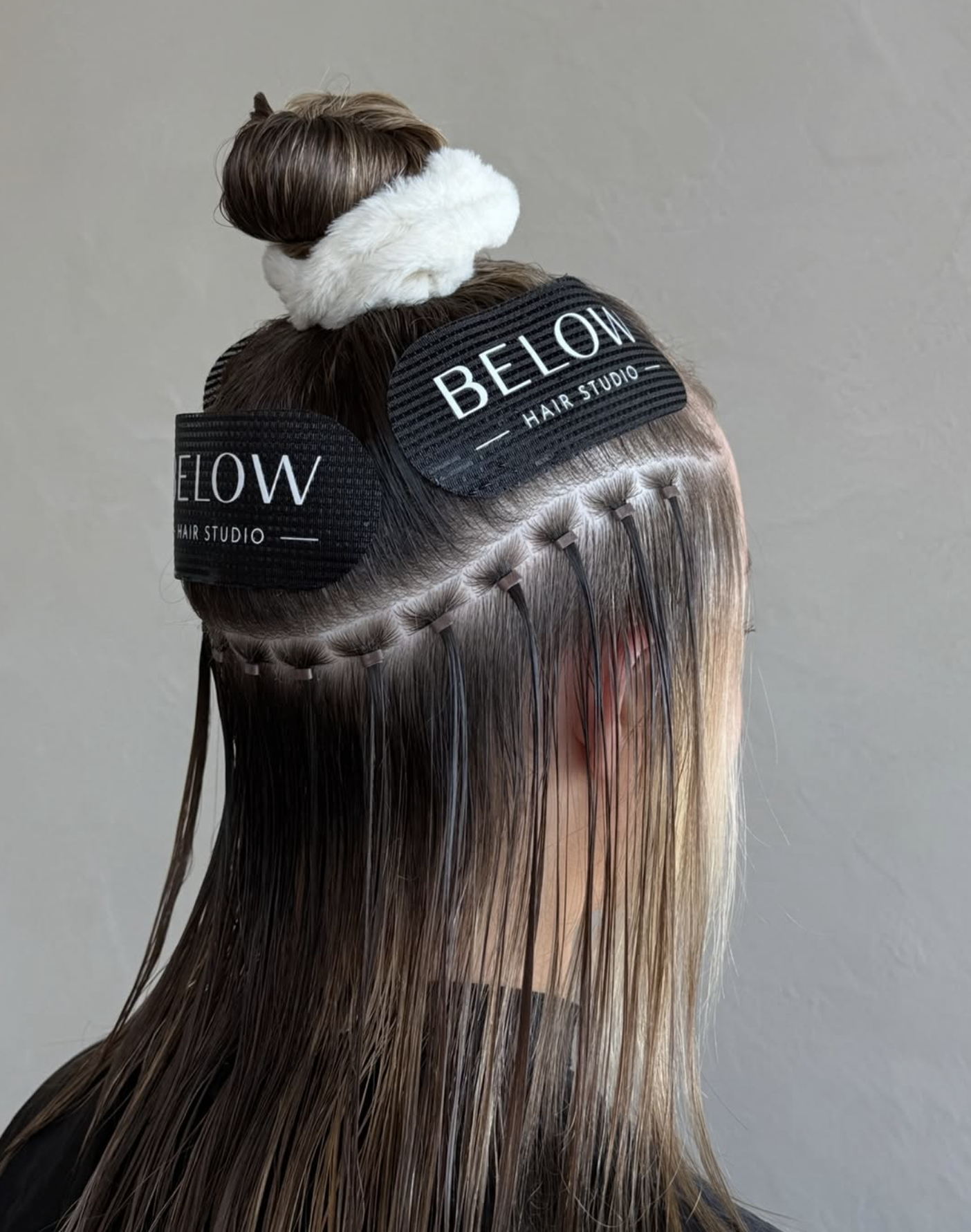
Brush more and brush smarter
Morning, night, and before every wash. Extensions tangle from the bottom up — tiny knots form at the ends and slowly migrate toward the attachment point, and by the time you feel them they've already been creating tension on your natural hair for days. Two brush-throughs a day catches them early. Always hold your hand at the attachment point for support — use a soft bristled brush and never brush top-down with no resistance.
Here's the part most people miss: the underneath sections. Everyone brushes the top layer and calls it done. The hair in between your wefts, around your nape and behind your ears — the sections you can't easily see — that is where matting quietly starts.
Your ponytail placement is slowly doing damage
Shocker. Wearing your hair up in the exact same spot every single day…same height, same position.. Of course it will create a friction groove right where the extensions sit. Over weeks and months, that repeated pressure and tension in one spot weakens the attachment and stresses your natural hair underneath. The fix is genuinely simple: rotate where you wear your ponytail. High one day, low the next, side part the day after. Spreading the tension load across different points makes a real difference to longevity.
Wash smarter, not more — and watch where the dry shampoo goes
Two washes a week is enough for most people with extensions. When you do wash: shampoo at the scalp only, let it rinse down through the lengths, and never scrub or bunch the extension rows. Conditioner and masks on mid-lengths and ends only — away from the bonds or weft. Sulfate-free is non-negotiable; sulfates strip the hair and break down bonds faster than almost anything else.
Now — dry shampoo. We love it too, but this is where people unknowingly cause problems. Spraying it directly at your roots means product residue lands on your bonds and attachment points. Over time that buildup weakens adhesive and causes slippage. The fix: spray into your hands first, then work it through your roots. Takes five extra seconds and your bonds will thank you for it.
If you're on hard water (hi, Alberta): Mineral deposits from hard water coat the hair shaft and make extensions feel rough, dull, and harder to manage — way faster than they should. A chelating or detoxifying shampoo strips that mineral buildup and genuinely resets the hair. Most clients have no idea hard water is even a factor. If your extensions feel different than they did at install and you haven't changed anything else, this is probably a very strong factor as to why.
Extensions are THIRSTY — treat them like it
Your natural hair gets a constant slow drip of moisture from the oils your scalp produces, all the way from root to tip. But guess what? Your extensions receive exactly none of that. They depend entirely on what you give them. Your extensions are constantly saying, “Help me im poooooor” in a Kristen Wiig voice. A weekly hydrating mask on the mid-lengths and ends isn't a luxury add-on — it's literally basic upkeep. A leave-in hydrating treatment every wash day and a couple of drops of oil on the ends before bed is what keeps extensions looking like healthy hair instead of straw. Skip the hydration step consistently and you'll feel the texture change honestly within a few weeks.
Know your heat safe zone
Heat tools are fine on extensions — but there's a safe zone most people don't know about. First of all, keep your flat iron or curling wand at least an inch below the attachment point. Dragging a hot tool right across a keratin bond or tape weft loosens it — the heat literally softens the adhesive. This is one of those things that doesn't cause an obvious problem immediately, but shows up at your move-up appointment as slippage that shouldn't have happened yet. One inch of clearance, every time. Set it as a rule and don't think about it again.
Sleep setup is a whole thing — here's what actually works
A loose braid or low ponytail before bed is the baseline. But the surface you're sleeping on matters almost as much. Cotton pillowcases have a microscopically rough texture that catches on the hair cuticle — thousands of tiny snags happening every night while you move around. Silk or satin creates a smooth surface the hair can slide across instead of gripping. Silk is the premium option; satin is the budget-friendly version that works nearly as well and costs almost nothing. Either one will noticeably reduce morning tangles within the first week.
And please — never go to bed with wet extensions. Wet hair is weaker and more elastic, and the combined weight of extensions plus hours of pressure on damp attachment points creates the conditions for matting and breakage that's genuinely hard to reverse.
The thirty-second habit that adds weeks to your set: Loose braid, satin pillowcase, done. It sounds almost too simple but this one bedtime habit is the single most impactful thing most of our clients can add. The clients who do it consistently always get more life out of their sets.
Swimming isn't off limits — but prep first
Chlorine and salt water both strip moisture from hair — and because your extensions have no natural oil barrier, they're hit harder than your natural hair is. They also oxidize the colour in extensions faster, which means fading and brassiness showing up sooner than it should. Before you swim: apply a leave-in conditioner or a few drops of hair oil through the mid-lengths and ends to act as a barrier. Braid your hair, put it up, and keep it out of the water as much as you can. Rinse with fresh water immediately after. It's not complicated — it just has to happen before you get in, not after.
Don't stretch your move-up appointment
Extensions grow out with your natural hair — typically about half an inch a month. As they migrate further from the scalp, the tension on your roots gradually increases. Leave them too long and you get tangling near the attachment points, real stress on your natural hair, and sometimes damage that takes months to recover from. Move-up appointments aren't just cosmetic — they're what protects your hair underneath the extensions. Most of our clients come in every six to eight weeks. If you're pushing ten, book it now. The longer you leave it, the more work is involved and the harder it is on your natural hair.
The clients whose extensions always look incredible aren't doing anything complicated. They've just built these habits into their routine until they're automatic. Start with two or three that feel manageable, get consistent, and add the rest. Your hair — and your wallet — will notice.
Every product we mentioned — the chelating shampoo, the loop brush, the leave-in, the finishing oil — we stock them all. These are the exact things we use and recommend to our extension clients every day.